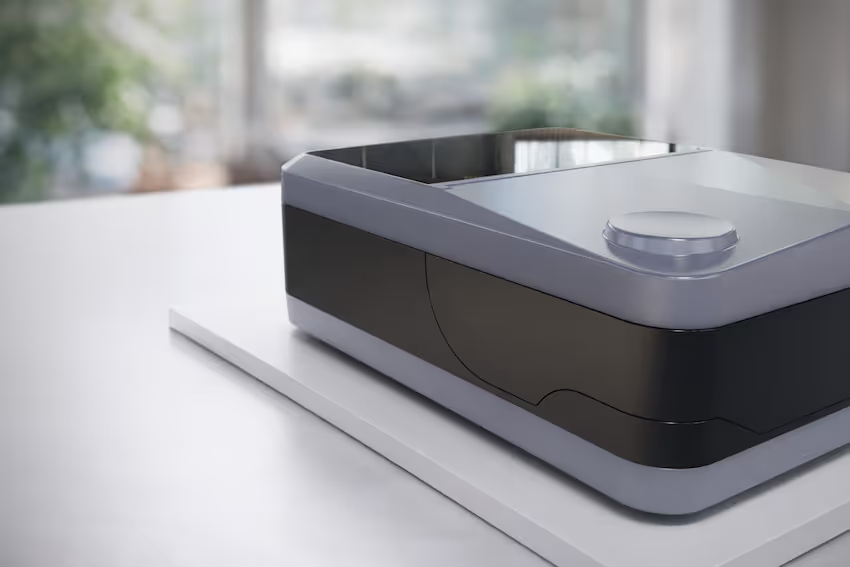
Non-invasive monitoring for the next generation of health devices
Redefining how the world measures health without invasive procedures
At RSP Systems, we translate Raman spectra into robust quantitative measurements using algorithms trained on real-world data - bridging the gap between theoretical promise and real-world performance.
Raman spectroscopy captures the signal

Real world data provides context

The algorithm delivers the understanding

Non-invasive, pain-free technology designed for real-life use
We have conducted
20Clinical studies
We have collected data from
+850people
We have gathered
+300,000Data points
Our algorithms are trained on human
Large-scale datasets are collected across many individuals, conditions, and points in time.
Each measurement reflects a complex combination of biological, physiological, and measurement-related factors, resulting in data with high variability and rich information content.
Alongside these measurements, a reference is introduced, providing a consistent point of comparison across the dataset. This allows the system to observe how the measured spectra vary relative to a known reference under real-world conditions.
.svg)
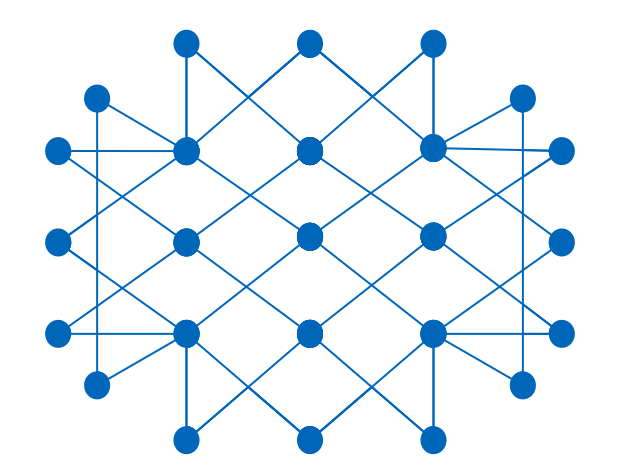
Structure begins to emerge from the complexity
As this data accumulates, structure begins to emerge from the complexity. Through continued exposure to real-world data, this structure converges into a model suitable for application to new measurements. Within the supervised machine learning, the algorithm encodes both invariant relationships and sources of non-informative variation as learned parameters. In doing so, the model learns which spectral information remains stable across conditions, and which does not contribute meaningfully to prediction. This learned representation enables relevant signals to be identified consistently when the model is applied to new data.
RSP Systems has an extensive IP portfolio spanning 8 patent families with 43 patents granted and 37 pending
Our IP portfolio covers the full vertical including optical device designs and complementary proprietary multivariate analysis and have a broad application across all measurement methods for all analytes of interest.
50 participants showed that the P0.5 prototype achieved accurate glucose measurements using a guided calibration method with substantially fewer calibration points, supporting practical future use
15 participants showed that the P0.3 prototype can track glucose, including hypoglycaemia, in daily life and controlled settings.
A study with 3 participants showed that the P0.1 prototype outperformed the WM3.4NR model in tracking glucose during controlled excursions, demonstrating technological improvements between generations.
10 participants showed that the WM3.4NR prototype could detect glucose signals during high-frequency measurements, but longer calibration periods are needed for reliable long-term predictions.
45 participants demonstrated that the Prototype 0.3 device accurately followed glucose patterns in both in-clinic and outpatient settings, even during large fluctuations.
10 participants showed that the WM3.4NR prototype safely and accurately tracked glucose dynamics, performing best against interstitial microdialysis references.
A Raman-based non-invasive glucose monitor can achieve accurate measurements with only a short calibration period using a pre-trained model.
The study presents a portable, non-invasive glucose sensor based on confocal near-infrared Raman spectroscopy. The device is designed for safe and user-friendly operation, featuring built-in safety mechanisms, wireless connectivity, and a graphical interface. Clinical testing showed no adverse skin reactions, confirming its safety for repeated use. The sensor measures glucose by detecting Raman signals from the upper living layers of the skin, while minimizing interference from outer dead skin layers. This confocal setup improves signal consistency and reduces variability caused by skin contact. Although minor differences in signal intensity were observed across different skin types, the overall spectral patterns remained consistent. Glucose information is extracted from the recorded spectra using multivariate regression techniques, enabling accurate prediction of physiological glucose levels.
50 participants showed that the P0.5 prototype achieved accurate glucose measurements using a guided calibration method with substantially fewer calibration points, supporting practical future use
15 participants showed that the P0.3 prototype can track glucose, including hypoglycaemia, in daily life and controlled settings.
A study with 3 participants showed that the P0.1 prototype outperformed the WM3.4NR model in tracking glucose during controlled excursions, demonstrating technological improvements between generations.
10 participants showed that the WM3.4NR prototype could detect glucose signals during high-frequency measurements, but longer calibration periods are needed for reliable long-term predictions.
45 participants demonstrated that the Prototype 0.3 device accurately followed glucose patterns in both in-clinic and outpatient settings, even during large fluctuations.
10 participants showed that the WM3.4NR prototype safely and accurately tracked glucose dynamics, performing best against interstitial microdialysis references.
A Raman-based non-invasive glucose monitor can achieve accurate measurements with only a short calibration period using a pre-trained model.
The study presents a portable, non-invasive glucose sensor based on confocal near-infrared Raman spectroscopy. The device is designed for safe and user-friendly operation, featuring built-in safety mechanisms, wireless connectivity, and a graphical interface. Clinical testing showed no adverse skin reactions, confirming its safety for repeated use. The sensor measures glucose by detecting Raman signals from the upper living layers of the skin, while minimizing interference from outer dead skin layers. This confocal setup improves signal consistency and reduces variability caused by skin contact. Although minor differences in signal intensity were observed across different skin types, the overall spectral patterns remained consistent. Glucose information is extracted from the recorded spectra using multivariate regression techniques, enabling accurate prediction of physiological glucose levels.
50 participants showed that the P0.5 prototype achieved accurate glucose measurements using a guided calibration method with substantially fewer calibration points, supporting practical future use
15 participants showed that the P0.3 prototype can track glucose, including hypoglycaemia, in daily life and controlled settings.
A study with 3 participants showed that the P0.1 prototype outperformed the WM3.4NR model in tracking glucose during controlled excursions, demonstrating technological improvements between generations.
10 participants showed that the WM3.4NR prototype could detect glucose signals during high-frequency measurements, but longer calibration periods are needed for reliable long-term predictions.
45 participants demonstrated that the Prototype 0.3 device accurately followed glucose patterns in both in-clinic and outpatient settings, even during large fluctuations.
10 participants showed that the WM3.4NR prototype safely and accurately tracked glucose dynamics, performing best against interstitial microdialysis references.
A Raman-based non-invasive glucose monitor can achieve accurate measurements with only a short calibration period using a pre-trained model.
The study presents a portable, non-invasive glucose sensor based on confocal near-infrared Raman spectroscopy. The device is designed for safe and user-friendly operation, featuring built-in safety mechanisms, wireless connectivity, and a graphical interface. Clinical testing showed no adverse skin reactions, confirming its safety for repeated use. The sensor measures glucose by detecting Raman signals from the upper living layers of the skin, while minimizing interference from outer dead skin layers. This confocal setup improves signal consistency and reduces variability caused by skin contact. Although minor differences in signal intensity were observed across different skin types, the overall spectral patterns remained consistent. Glucose information is extracted from the recorded spectra using multivariate regression techniques, enabling accurate prediction of physiological glucose levels.